


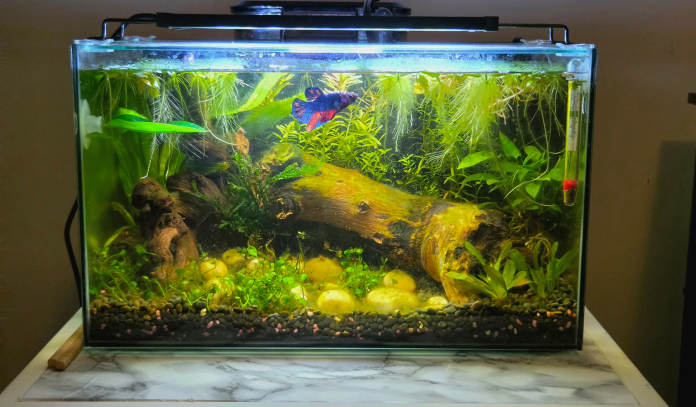
It is possible that you have heard bettas are really easy pets. I think they are not. If there’s one thing that breaks my heart, it is seeing a betta poorly taken care of. I find that a lot of people tend to think of bettas as simple to maintain, often leaning toward giving them a cute little tank with colorful decorations to match their vibrant and fun colours, fish food, and occasional water changes. I’ll tell you something — I used to be one such betta keeper. Now, however, it is a completely different story. It was a lot of careful research and a hassle, but it was worth it — my betta Bono is a happy healthy fish living in a cycled, tropical temperature planted aquarium with natural tannins from mopani wood, fed top rated betta fish pellets, with an automatic light that turns on and dims down on a fixed schedule. This is why I feel I can confidently say: keeping a betta is not “simple.” At least not in a traditional sense, I believe.
For starters, there is definitely a learning curve when you first get into fishkeeping. Immersing yourself into aquatic caretaking is a stark contrast to other types of pets, because everything you do is contained within a tiny living ecosystem. I would agree that bettas can be a great beginner fish for people — but this is very different from finding a pet that is low-maintenance and easy to have. I believe in giving pets the absolute best you can give them, and with betta fish, that includes taking the time to learn about their needs for an optimal life.
A person new to the fishkeeping hobby might find themselves overwhelmed with understanding the nitrogen cycle and its part in cycling a tank — I know I did. Also, the equipment goes well beyond just the tank itself. The minimum recommended size for a betta fish tank is five gallons, and in there, you will need to fit a filter, a heater, and adequate decorations. If you want to go all the way and provide your betta buddy with the best environment possible, you may find that live aquatic plants will be the best choice. Finding the right type of light to sustain the tank was also a challenge, since too much light can cause an algae problem, and not enough of it might starve your plants.
In my case, I have a five gallon tank set up just for Bono. I’m running a Marina S10 power filter customized with ceramic rings and sponges in the canister for longevity and solid biological filtration. My heater is the reliable 50 watt Aquael UltraHeater, it’s in charge of maintaining Bono’s water to a cozy 80 degrees Fahrenheit. Some of my plants consist of fast growing plants such as rotala orange juice, amazon frogbit, and red rood floaters. Fast growing plants consume a lot of nutrients, which helps keep algae in check. The light I use to maintain them is the NICREW SkyLed Plus aquarium light — it turns on and off gradually to simulate sunrise and sunset, and its light settings are highly customizable as well.
Then, there is learning about common illnesses and how to treat them. As it happens, taking your fish to the vet may be more complex than other animals, and it may be hard to find a vet that wants to see a fish patient. As such, you may find that if your betta contracts an illness, it is up to you to treat it. Internet forums will become your best friend, trust me. When I first got Bono, I noticed he was brushing against the leaves of his tank quickly — this was abnormal behaviour. I then did research to discover what this behaviour was, and found out it is called “flashing”, which is essentially an itchy betta fish trying to scratch. The next step was to find out why he was itchy. Long story short, I found out it was due to a parasite called “gill flukes”, and then I had to order the medicine online because no pet shop had it available.
I would encourage anyone that wants to get a betta fish to do ample research beforehand, find out what are the things that will be needed to adequately take care of a new aquatic friend, and prepare accordingly. Having a betta is beautiful, and I wouldn’t want to deter someone from getting one. What I want to spread awareness about is to avoid falling into misinformation traps — research is key! It may not be as easy as you thought at first, but once you get the hang of it, it’ll be extremely rewarding.
